Energy-Efficient Artificial Intelligence

TU Delft · Department of Microelectronics

Latest newsGrainSpeech preprint: compact speech synthesis with finer detail

01 / Inside the research

Select a module. Explore the ideas inside.

THE EMI CO-DESIGN ENGINEEXPLORE THE LAYERS ↘
HARDWARE
ALGORITHMS
ALGORITHMS ↔ HARDWARESELECT A MODULE

Research direction 05

AI-Native Chip Design

AI agents compose, connect and refine circuit building blocks — from transistors to systems.

Agentic AI · chip design
AI agents compose an analog and digital circuitTransistor building blocks assemble into analog circuits alongside a grid of digital logic gates. Interconnects join the pieces into one system as the agent plans, composes, connects and refines the design. This is a concept illustration.DAI design agentANALOG CIRCUITSDIGITAL LOGICM3M4M1M2M5M6M7CcVBPVBNIN+IN−OUT
PlanComposeConnectRefine
Concept animation · analog + digital building blocks
ChipJevExplore our analog circuit design demo

Research direction 01

Learning better signals.

Learning-based models, calibration and digital predistortion for more efficient radio-frequency and mixed-signal systems.

With and without AI-DPD
With and without AI-DPDTwo synchronized paths compare the same radio signal and power amplifier. Without AI-DPD, the PA produces a compressed, distorted waveform. With AI-DPD before the PA, pre-correction restores a clean output. Both outputs remain visible together.Without AI-DPDDistortedDirectPAWith AI-DPDCleanAI-DPDPAWith and without AI-DPDTwo synchronized paths compare the same radio signal and power amplifier. Without AI-DPD, the PA produces a compressed, distorted waveform. With AI-DPD before the PA, pre-correction restores a clean output. Both outputs remain visible together.Same RF inputWithout AI-DPDDirectPADistortedWith AI-DPDAI-DPDPAClean
Same inputSame PACompare outputs
Same signal, same PA. AI-DPD pre-shapes the input to counteract distortion.
Explore signals
Keywords & selected papers

Research direction 02

Compute only what changes.

Brain-inspired algorithms and accelerators that exploit temporal and spatial sparsity to reduce unnecessary computation.

Dense vs. change-driven
Dense vs. change-drivenTwo matching networks receive the same four changed values, marked by orange rings. Dense computing activates all eighteen neurons. Change-driven computing activates only the four changed neurons, leaving fourteen crossed-out computations idle. Counts refer to this illustration, not measured performance.Same update · 4 changed valuesDense computing18 computationsChange-driven4 compute · 14 skippedOrange rings mark changes · × marks skipped workDense vs. change-drivenTwo matching networks receive the same four changed values, marked by orange rings. Dense computing activates all eighteen neurons. Change-driven computing activates only the four changed neurons, leaving fourteen crossed-out computations idle. Counts refer to this illustration, not measured performance.Dense computing18 computeChange-driven4 compute · 14 skip
Same changesCompareSkip repeats
Illustrative update: 4 of 18 values change. Dense computes all 18; change-driven computes 4 and skips 14.
Explore sparsity
Keywords & selected papers

Research direction 03

Perception at the edge.

Efficient visual perception, eye tracking and intelligent hardware for extended reality and wearable applications.

Seeing through events
Seeing through eventsAn eye looks from side to side. The moving edges produce event pixels, which guide a moving gaze marker.Eye motionEvent streamGaze estimateTrack the moving edges, without processing every pixelSeeing through eventsAn eye looks from side to side. The moving edges produce event pixels, which guide a moving gaze marker.Eye motionEventsGazeFollow changes. Update the gaze.
MotionEventsGaze
Eye motion becomes sparse events, then a continuously updated gaze estimate.
Explore vision
Keywords & selected papers

Research direction 04

Small devices. Useful intelligence.

Energy-efficient speech processing, keyword spotting and radar-based activity recognition for embedded systems.

Intelligence at the sensor
Intelligence at the sensorA microphone waveform and radar echoes flow into an edge AI chip. Its outputs identify voice and motion activity.SpeechRadarEdge AIVoiceMotionIntelligence at the sensorA microphone waveform and radar echoes flow into an edge AI chip. Its outputs identify voice and motion activity.SpeechRadarEdge AIVoiceMotion
Listen & senseEdge AIRespond
Speech and radar signals become useful information on a compact edge device.
Explore speech & sensing
Keywords & selected papers
Five directions. One shared pursuit of efficiency.All research & demonstrations
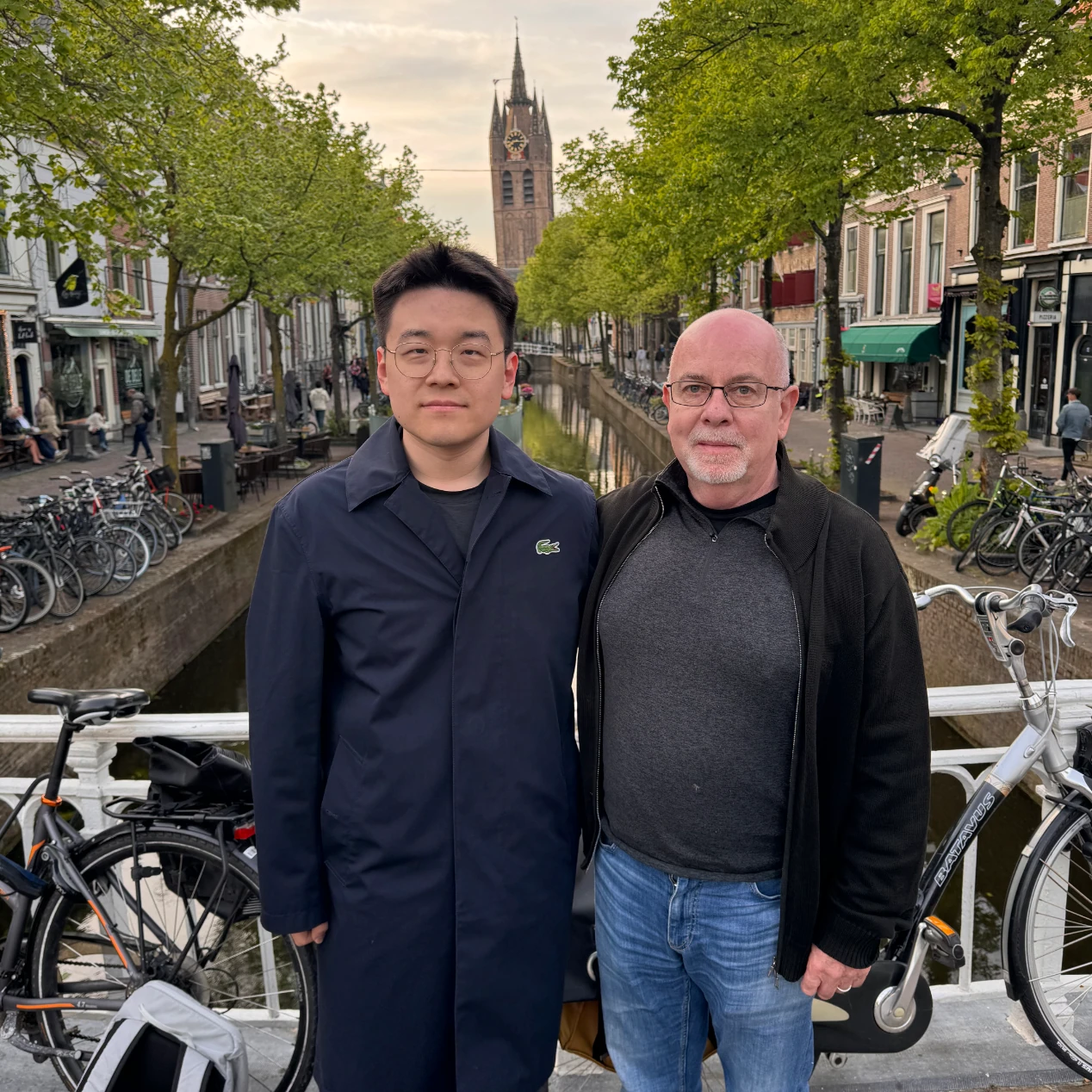
Chang and Chris in Delft
Ang @ ISCAS 2025, London, UK
Chang's Visit to Prof. Anding Zhu's Lab
LIFE, IN GOOD COMPANY
Chang's Visit to Prof. Anding Zhu's Lab

02 / The people behind EMI

Meet our team.

Efficient AI, built together at TU Delft.

Dr. Chang Gao, principal investigator of EMI Lab

Principal investigator

Dr. Chang Gao

Tenured Assistant Professor · Edge AI

Neuromorphic algorithm–hardware co-design for energy-efficient edge AI.

04 / Fresh from the lab

Always in motion.

All news
Publication

MSc Navya Agarwal’s Work Accepted at ICCAD 2026

Congratulations to EMI MSc student Navya Agarwal, whose internship research at imec has been accepted for presentation and publication at the 2026 IEEE/ACM International Conference on Computer-Aided Design (ICCAD 2026).

Publication

PhD Student Yi Zhu Published in IEEE JSTEAP

Excited to share that our article by our industrial PhD student Yi Zhu, “Deep-Learning Based Hardware-Efficient Load Identification for Power Amplifiers,” has been published in the IEEE Journal of Selected Topics in…

Shared ambition. Real support.

Dutch Research Council (NWO)European Commission (MSCA)NXPAmpleonGlobalFoundries
Grants, collaborations & awards

Make your next connection

What will you bring?

Fresh questions. Different perspectives. Your next big idea.

Find your place at EMI

Around the world

Our global visitors.

—recorded visitors
—countries & territories

Loading visitor statistics…

Select a country on the map or in the list.
Country / territoryVisitors

Loading country data…

Source: Google Analytics

About these numbers

Historical visitors are distinct users recorded by Google Analytics through yesterday. A person can appear in more than one country, so country counts may not add up to the total. The recent view shows users active within the last 30 minutes and refreshes every minute while this section is visible. Locations are approximate; unreported or unavailable data is not counted as zero. Analytics may omit visits or withhold some data.

Map adapted from MapSVG / SVG Maps · CC BY 4.0